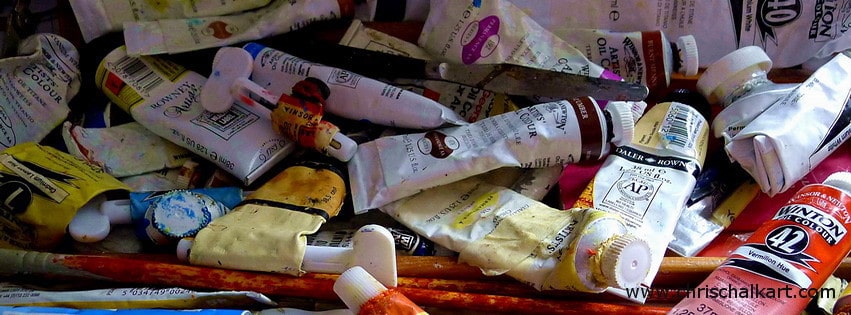
Like most other professions, hobbies or pastimes, oil painting comes with a overwhelming array of extra equipment, accessories and latest must-haves, that the art magazine advertisers will say you need if you’re serious about making great art.
But like most other professions, hobbies or pastimes, you need very little of it. In fact, you can be at a distinct disadvantage if you own and use too much ‘art fluff’, as you risk becoming a jack of all trades (accessories), and the master of none.
Imagine if you’d told Rembrandt that he should stop using his basic set-up, get himself 9 different types of red and some ‘revolutionary new brushes’ with a famous artist’s name on them (probably his!), he’d have smacked you round the ear with his home made mahl stick and thrown you out of his makeshift studio.
I know that it’s fun to get a new art accessory now and again, some new tubes of paint you haven’t tried before, a fancy non-stick stay-wet palette, or a weird shaped brush that you’re pretty sure you need even if you don’t know what for yet, the point is that you don’t NEED any of those extras to paint great pictures.
To paint with oils you need 3 things:
1) Oil Paint
If you want to spend money, this is where to spend it. Good oil paint really is worth the extra cost. Not only does better paint have more pigment in it ( less filler ), it covers better, flows better, looks richer, and goes much further.
Cheaper paint has synthetically produced pigment in it, not the same pigment as in more expensive paints. This isn’t necessarily a bad thing though, if you use large quantities of a certain colour it often makes sense to get a tube of ‘students grade’, rather than the much more expensive ‘artists grade’ paint.
I usually use students grade Ultra Marine Blue, Cadmium Red, Cadmium Orange and a couple of others colours.
Try and avoid very cheap oil paint though, it has no body, very little pigment, can be greasy and hard to use and is liable to put you off oil painting altogether.
2) Brushes
Expensive brushes will have you painting like De Vinci in no time, right? ..wrong, save your money for the paint.
Depending on your painting style, oil painting can be very hard on brushes, and canvas is very abrasive, wearing brushes down quickly. If you paint a lot, like me, your brushes will be ruined before you can say… ‘jeez, that brush cost me £10’. So in general, buy more affordable brushes and be brutal with them.
Having said that, it can be useful to own a couple of better quality small brushes, rigger brushes for instance, that you might need for fine detail work or signing your artwork.
You can buy student brushes in baulk from most art suppliers such as: Ken Bromley Art Supplies, Great Art, Jackson’s Art Supplies, Art Discount.
3) Support
You can of course paint on canvas, stretched canvas, hardboard, MDF, aluminium, or the side of last weeks breakfast cereal packet if you like. Your 2 best options when starting to oil paint are:
1. MDF ( medium density fibreboard ) or Hardboard ( high density fibreboard ). Both are great to paint on once sealed with a primer or gesso, and much cheaper to paint on than stretched canvas. At the time of writing you can buy a 8 x 4 foot sheet of hardboard, here in the UK, for £10 approx. Then you simply cut your sheet into your desires size boards.
2. Stretched canvas. Although quite expensive, if, like me, you prefer to paint on stretched canvas it pays to use good canvases. The wooden supports used in cheap stretched canvases tend to warp in time, and the actual canvas material can be coarse and of poor quality, meaning unless primed many times with gesso or similar, the dry coarse canvas will suck-up all your paint.
Note – If you plan on selling your paintings, cheap canvas won’t do at all. Of course you can practice on cheap canvases, but don’t use them for anything else. If the cost of good quality stretched canvas is prohibitive, then try hardboard or MDF, it’s much cheaper and great to paint on.
4) Yes I know I said 3 things, but…
You will need one more thing: paint thinners.
There are many sorts of paint thinners available: turpentine, odour-free thinners, turps substitute, various different oils e.t.c. but some ordinary white spirits from your local hardware store will do nicely for cleaning your brushes, equipment, and anything else you get paint on. If you’re sensitive to the smell of white spirit then try odour-free thinners instead.
Painting ‘mediums’ (that you mix in with your paint) is a whole other ball game, so I won’t cover those here, they are not a necessity.
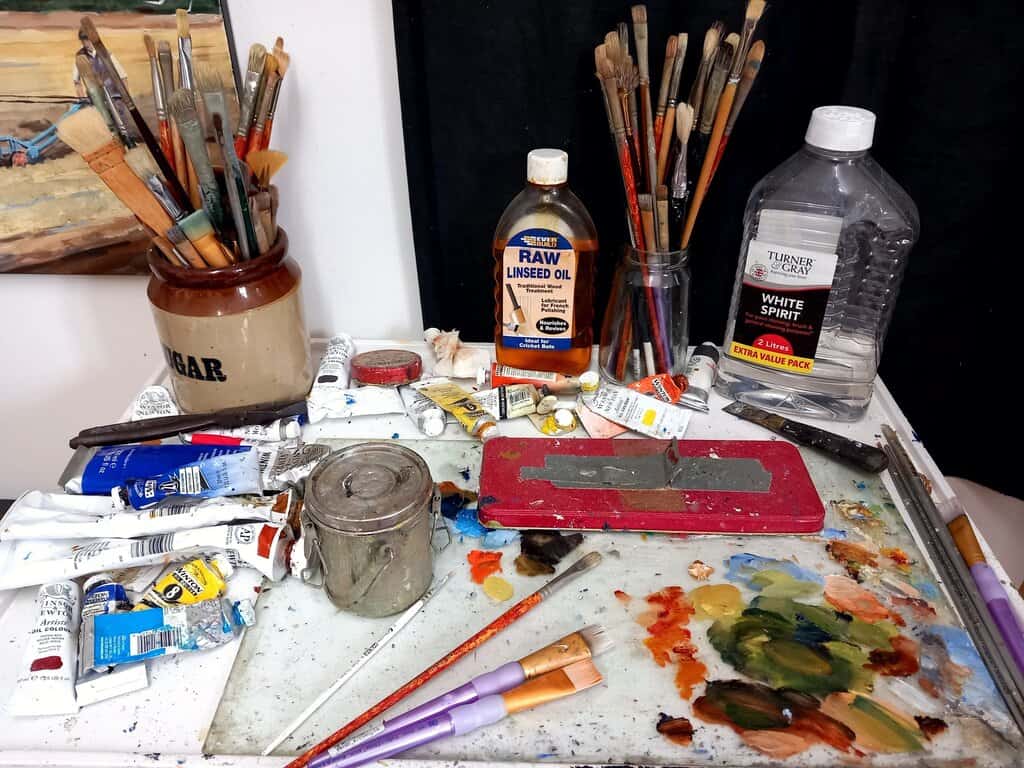
Above is what I have on my painting table. Essentially I just use oil paint, brushes and white spirit.
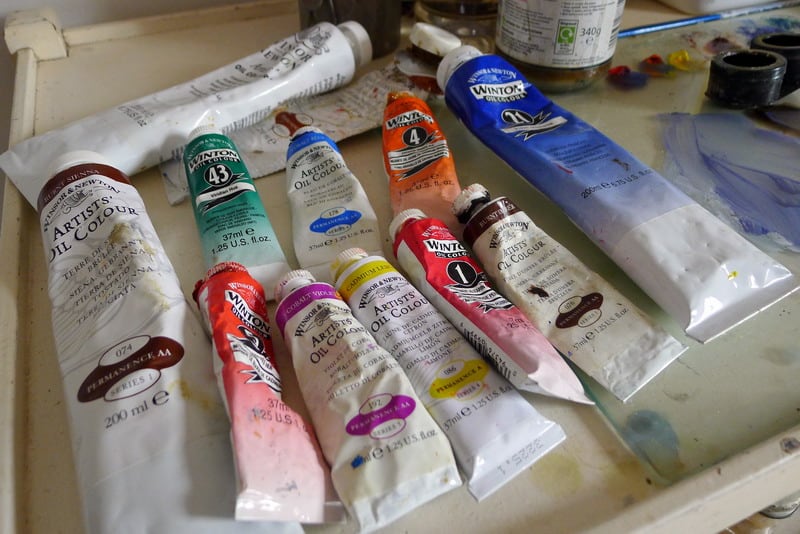
The paints I use are a mix of both artist’s & student’s grade. Most of my paints are Winsor & Newton, but I use other makes too.
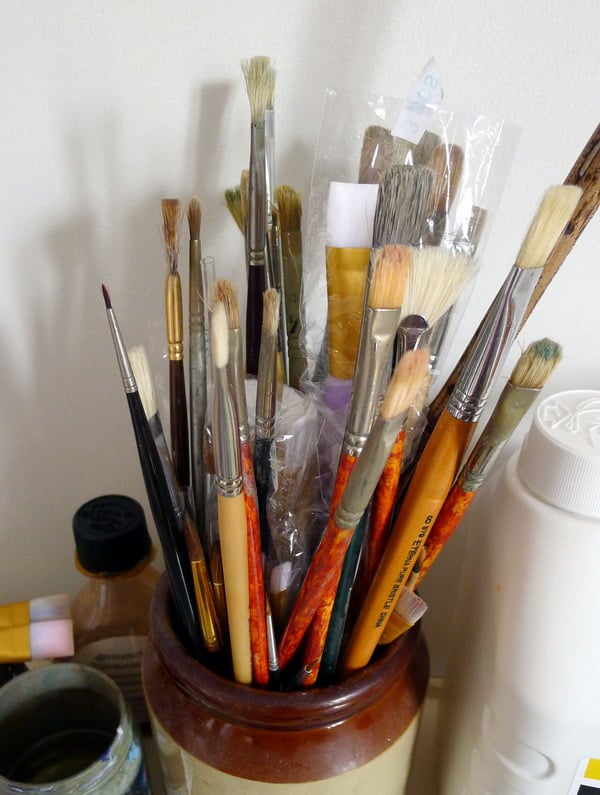
I don’t have any expensive brushes, just some nylon bristle and some hog hair bristle brushes of various sizes.
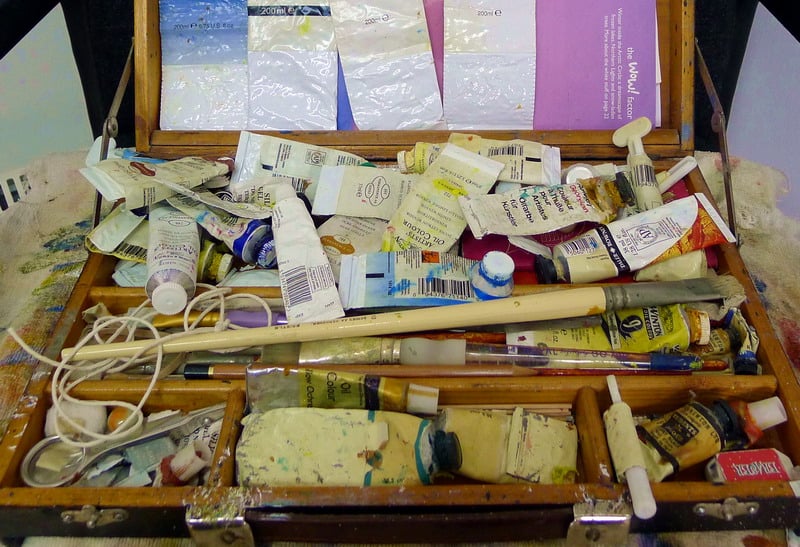
This was my mothers paint box, it’s 60 years old and counting. There weren’t many accessories around in those days.
So, if you find yourself daunted by the vast array of paints, brushes, mediums, do-dads, thingamies and accessories out there, rest assured that you need very little of it to get going, just get the basics listed above and enjoy painting.
Chris


Great Art is also very good for painting supplies… often have sales of paint and canvas and free postage… Odourless white spirit from B+Q is very good too– I can’t stand the smell of the original white spirit!
Good tips Diane, thanks!
Heel goed en boeiend om te lezen! Dit geldt voor olieverf, maar ook voor,pastelkrijt, waar ik mee werk.Fijne tips.
Bedankt Jolien, blij dat je het nuttig vond. ~ Chris
Ooh ok! I have some oils which I’ve always been too scared to use. I thought you had to mix them and thin them and do all sorts of technical stuff. But I can paint straight from the tube then? Thank you! Xx
Keep it simple Tania, just oils and a bit of thinners if you need it ~ Chris