I bought a couple of Winsor & Newton brushes once, they cost me about five pounds each and I ruined them in a week.
Oil painters don’t need expensive brushes, watercolour painters yes, it definitely helps, but oil painters, no. That said, an oil painter does need clean brushes.

If you use a dirty brush to mix your oil paint colours and tones, when you dip your brush into the different pigments and mix them together on a separate area of your palette, the dirty paint will come down out of the ferrule and spoil your colours.
The best way to mix colours and keep them clean and fresh is to use a palette knife to mix up your paints, and then apply the paint with a brush. Even if you do this, if you apply the paint with a dirty brush you will still get plenty of muddy paint and thinners leaching out of the bristles and ferrule if your brushes aren’t clean.
To combat this problem, a lot of artists will use a clean (different) brush for each colour that they are using, which obviously requires using a lot of brushes. Some artists instead use DARK brushes and a LIGHT brushes, keeping the lighter tones and the darker tones separated between different brushes.
I personally own at least 2 million brushes, I’m exaggerating of course, it’s more like 1 million, but I only really use 2 or 3 brushes for any particular painting, and I can do that because I clean my brushes well as I paint.
So what’s the best way to clean your brushes?
- A jam jar full of turps is okay, but every time you swish your brush about you’ll stir up all the muddy mess at the bottom.
- Two jam jars is better, one for the initial clean and a second one to clean off the stirred-up mess from the first wash, but a few brush washes later the second jar will be as bad as the first.
- Soap and hot water. This is great for getting a really good clean post-painting, but impractical when you’re sitting at your easel and in mid painting flow.
- A purpose built suspended sieve brush washer – yes, read on:
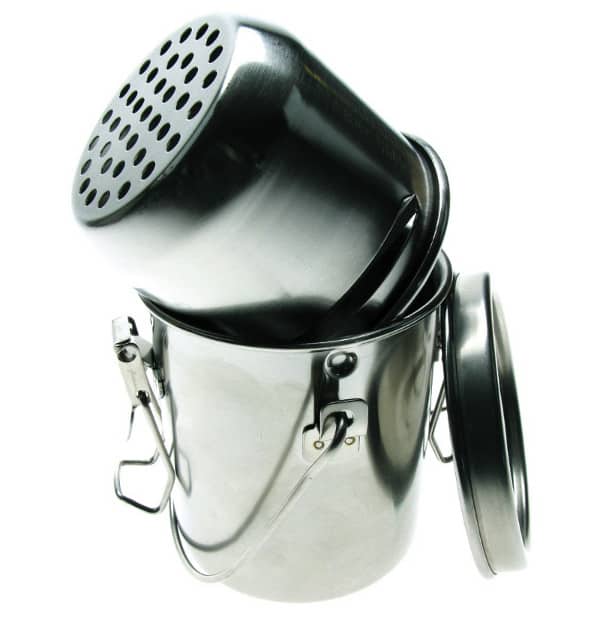
With a stainless steel artist’s brush washer like the one above, a metal sieve sits inside the main tub, about half-way down, this allows the paint to settle-out of the thinners after you’ve washed your brushes and remain undisturbed in the bottom of the tub. So when you next agitate your brush on the bottom of the sieve to wash it, it doesn’t stir up any paint residue, because the residue is below the sieve level (mage courtesy SAA).
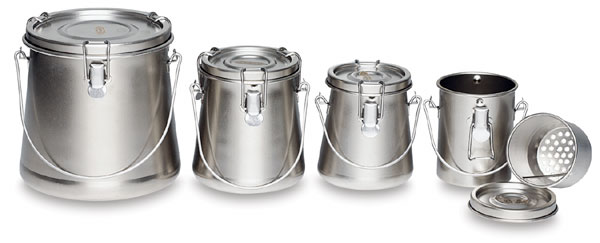
There are various size brush washers available, like these from Holbein and available at Dick Blick art supplies.
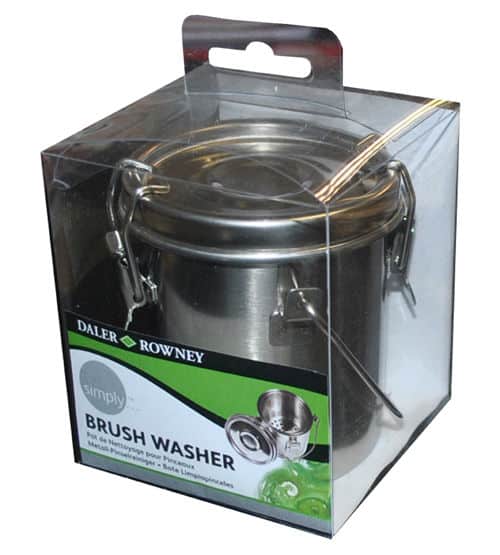
This Daler Rowney version is very similar to my own brush washer.
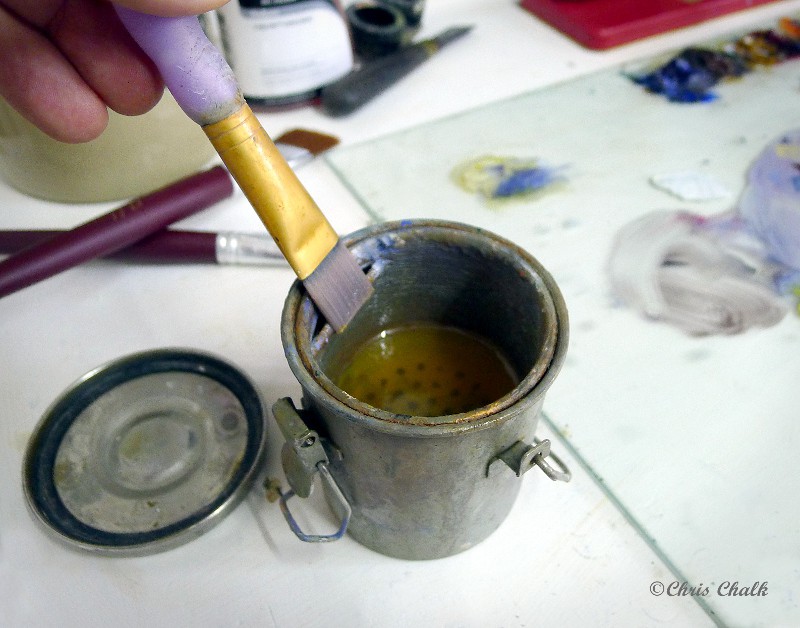
When you’ve used your brush washer a lot it looks more like mine. About once a week I do give it a proper clean, as the ‘gunk’ at the bottom builds up, but depending on how much painting you do it’s not necessary very often.
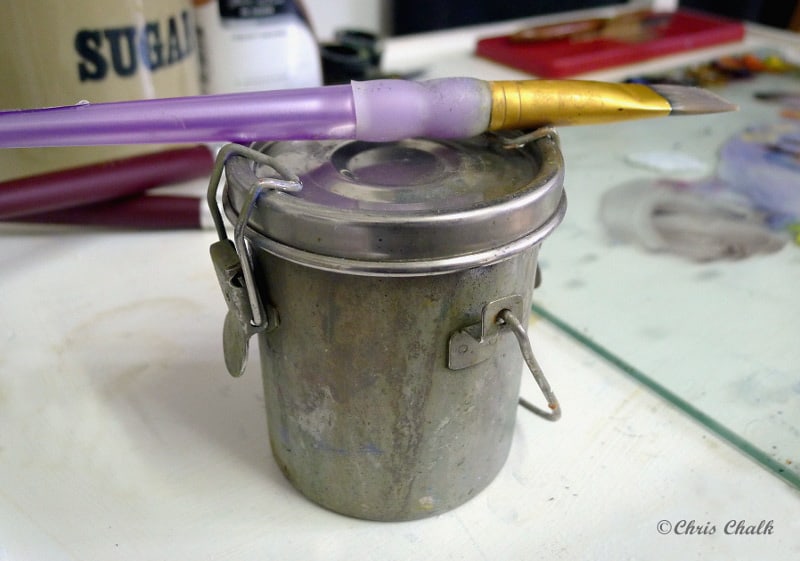
The lid has a rubber ring inserted that seals very tightly, so that once the lip is clipped on you can easily transport the brush washer without any spillage.
Where can you get one?
The brush washers above are very popular with artists, and readily available online. Try searching ‘Metal Brush Washers’ on google, or just check out the following links:
- Ebay – I bought my own brush washer online at Ebay.
- DickBlick – This is an American art supplies website, so the prices are in U.S Dollars, but they have a variety of different size brush washer available.
- Amazon – They sell a Daler Rowney brush washer.
- www.jacksonsart.com – A big supplier of art materials, they sell a very similar design to the others.
- Pullingers – Their brush washer uses the same principle, but are a different design, and because of that are a little cheaper.
Metal brush washers like this can to be used with any kind of thinners, be it turpentine, white spirit, or water, so can be used by most artists.
If you’re thinking of trying a metal brush washer to keep your colours clean and fresh, see why you should also consider using a glass palette to mix your paint on here.
Happy painting!
Chris


Perfect. This is just what I’ve been looking for an alternative to the Bob Ross version!
Thank you!
You’re welcome, I’m glad you found it useful Rob.
I have these jas jars but the sieve surface around the holes seems sharp. I am worried that might damage the hair on the brushes if I try and clean them by rubbing on it. I wonder if I should hammer them flat?
Hi Sarmed, If you paint with oils and use hog bristle brushes they should be robust enough to not be damaged, I’ve used my brush cleaner for 10 years with no trouble. If you use acrylic brushes however, which are much softer, this could be a problem perhaps. I’m not sure of a solution, other than to clean acrylic brushes a little less vigorously. Chris
Hi Chris, thank you for another v useful blog. At the moment I just use a plastic jug of water to swizzle my brushes in, however I’m always amazed at the amount of sludge at the bottom when I rinse it at the end of a painting session.
I am now thinking of getting one of these brush cleaners, but also had similar concerns to the previous commenter re the wearing down of my brushes. I suppose it’s a bit of a balancing act between the efficiency of the cleaner and the wear and tear on the brushes.
Hi Tania, I’m glad you found my post useful. It doesn’t matter which medium we use it’s amazing how much sludge settles at the bottom of a jar when we clean our brushes isn’t it. I assume you paint in watercolours or acrylics as you mention water, I think this type of metal brush washer would be fine for you if you don’t push the brushes down into the bottom forcefully. It would still clean your brushes and keep the dreaded sludge separate below. Chris
Hello,
Thank you for a nice guide.
But, have you used with a dark oil paint on brush and after soaking and drying the brush then painted with white paint to see if the white paint is contaminated ? I find that there are fine particles of paint (irrespective of paint manufac., inc. Harding etc) are still in the liquid as shown in your Image?
Gerry
Hi Gerry, yes that is going to happen, the only way to avoid dark/light contamination is to use a different clean brush for your lights. Try using, at least, one brush for your darks, and a different brush for your lights ~ Chris